Clio Care
Only what happened.
How Clio Care keeps AI honest in NDIS progress notes
The first NDIS software business certified by Responsible AI Australia built its product around a single rule. A note contains only what the worker saw.
Kavinda Perera
Founder, Clio Care
October 6, 2026 • 7 min read
Client

Founder
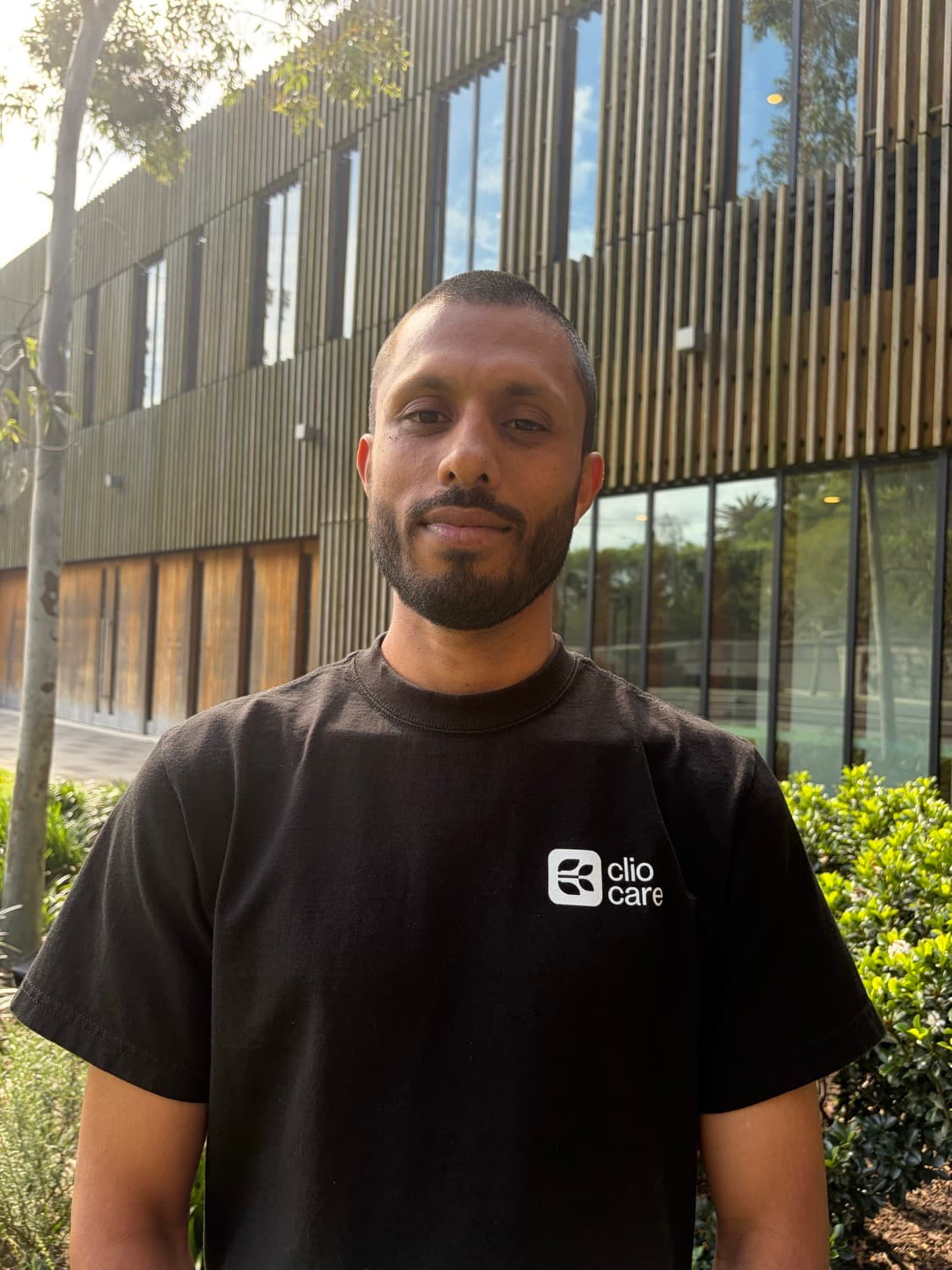
Kavinda Perera
Sector
Disability support software (NDIS)
Based in
Sydney
Certification tier
Govern
It is late on a weeknight somewhere in Sydney. A support worker has just finished a long shift with an NDIS participant. Before they can call it a day there is one more job, and it is unpaid. They need to write the progress note.
Progress notes are the record of what happened in a shift. They are read by plan managers, support coordinators and auditors, and they can shape the supports a participant receives. For an independent worker running their own practice, the notes sit alongside invoices, service agreements, receipts and reports, and all of it lands after hours.
AI tools promise to take that burden away. Describe the shift and a draft appears. The trouble, as Clio Care founder Kavinda Perera puts it, is what many of those tools add along the way.
“In disability support, a note isn't just paperwork. It's a record about a real person that can shape their supports. An AI that fills in details the worker never saw isn't saving time, it's creating risk. We built Clio so every note contains only what actually happened, and we test that before every release.”
In most writing, a tool that pads out a draft is a style problem. In an NDIS record it is something else entirely. A mood that was never observed. Engagement that was never described. Progress towards a goal that was never discussed. Each one is a false statement about a real person, signed by a worker who did not write it. A note that says more than the worker saw can hurt the participant it describes and expose the worker whose name is on it.
Clio Care was built to make that impossible.
What Clio Care does
Clio Care is documentation software for independent NDIS support workers. After a shift, the worker describes what happened in their own words, by voice or by typing. Clio turns that account into a structured NDIS progress note. The worker reviews it, edits it and signs it. Clio also handles the rest of a sole trader's admin, from shifts and invoicing with NDIS support item codes through to receipts, service agreements and reports.
It is built and run in Sydney, it is available on the web and in the app stores, and in October 2026 it became the first NDIS software business certified by Responsible AI Australia, at the Govern tier.
A standard anyone can hold Clio to
Rather than describe its approach in general terms, Clio publishes a Note Integrity Standard that every note must meet. It is public, and it is written so that workers, providers and plan managers can hold any AI note tool to it, including Clio itself. Organisations are welcome to cite it. It has six requirements.
01
Content accuracy
The note contains only what the worker provided.
02
Gap identification, not gap filling
Where a detail is missing, Clio marks it for the worker to complete. It never invents one, and a note cannot be signed until the marked details are filled in.
03
Generation preserved, edits recoverable
The original AI draft is kept alongside whatever the worker signs, so their professional judgement is on the record.
04
Worker voice
The note reflects the worker's own account, without embellishing it or dressing it up in clinical language.
05
Participant specificity
The note describes what happened with this person on this day, not generic language that could apply to anyone.
06
Regulatory context recognition
Clio recognises NDIS context, such as a possible reportable incident, and flags it for the worker to consider.
Two things set the standard apart from a page of good intentions. The first is that it is enforced. Every change to how Clio writes notes is tested for invented content before it goes live, and the results are read note by note. A change does not go live if it makes notes less accurate than the version before it.
A test anyone can run
The standard invites readers to check it for themselves. Open any AI note tool and write “Took client to the shops. Helped with lunch.” Then generate a note. If the note adds a mood, a level of engagement or progress towards a goal that was never written, the standard has not been met.
The second is that Clio keeps looking for its own mistakes. It does not assume its notes are right. It regularly checks the quality of the notes Clio produces, for any sign that something has gone wrong. Because the original AI draft of every note is kept, Clio can see exactly what the AI wrote and what the worker changed. When a review finds a problem, the cause is traced, fixed and covered by new tests before the fix is released.
The point is not that Clio never makes mistakes. It is that Clio looks for them, can see exactly what happened, and fixes them before they spread.
Where the idea came from
“I've worked where medicine and law meet, and a single record can decide someone's outcome. Participants in the NDIS deserve records held to that same standard, and the workers writing them deserve tools that help them get it right.”
That background shows in the design. Where medicine and law meet, the record is the evidence, and nobody gets to tidy it up after the fact. Clio treats a progress note with the same seriousness. The original draft and the worker's edits are both kept. The worker's name on the note means the worker's account is what the note contains. And when something is missing, the tool asks rather than guesses.
How Clio governs its AI
The Note Integrity Standard covers what a note may contain. Clio Care's Responsible AI Policy covers everything around it. Four commitments stand out.
The worker is always the author
The AI prepares drafts. Nothing is final until the worker signs it, and every note Clio drafts says that AI helped write it.
Clio makes no decisions about anyone
It is never used for eligibility, funding, supports or access to services.
Information is never used for training
Participant information is never used to train AI models.
Governance is written down
Clio has a public Responsible AI Policy and an internal governance framework covering risk, testing, monitoring and escalation.
Why certification, and why now
As more AI tools write records about people with disability, Clio wanted its approach checked independently against Australia's AI Ethics Principles, rather than asking workers, participants and providers to take its word for it.
“Certification is a check we can't give ourselves. We hold every note to our own standard, and having someone independent look at how we govern the AI keeps us honest as we grow.”
The Govern tier is the highest of the three Responsible AI Australia tiers. To reach it, Clio Care signed the Responsible AI Pledge, published its Responsible AI Policy and showed an internal governance framework that covers risk, testing, monitoring and escalation. For the people on either end of a progress note, that assessment is the point.
“The worker signs the note, and their name is on it. The participant is the person it describes. Certification shows that someone other than us has checked the AI behind those notes is governed properly.”
The timing matters too. From 10 December 2026, the Privacy Act requires the businesses it covers to disclose automated decision-making in their privacy policies. The Australian Government has also announced Australian Standards for AI, which it expects to legislate in 2027. AI is already writing records about people with disability. Clio Care has published how its AI works, states in its privacy policy that the AI makes no decisions about anyone, and has now had its approach independently assessed.
What it means for the sector
“AI is already writing records about people with disability, and there's very little guidance on how it should. An independent standard gives workers, providers and plan managers a way to tell the tools apart. The more of us who commit to one, the more people can trust AI in this space.”
Every certified business raises the floor a little for what the market should expect. Clio Care has done something more specific. It has published a test that anyone can run, on any tool, in under a minute. That is a standard the whole sector can borrow, and it is one Responsible AI Australia was glad to assess.
For a support worker finishing a shift late on a weeknight, it comes down to something simpler. The note they sign says what they saw. Nothing more.
Responsible AI Australia certifies Australian businesses across three tiers, Commit, Embed and Govern, recognising progressive levels of commitment to ethical and responsible AI practice. To learn more about certification, get in touch.
About the client
Clio Care is Sydney-built documentation software for independent NDIS support workers. It turns a worker's own account of a shift into a structured progress note that the worker reviews, edits and signs, and it handles the rest of a sole trader's admin. Founded by Kavinda Perera, Clio Care is certified at the Govern tier with Responsible AI Australia. Media and partnership enquiries go to hello@cliocare.com.au.