Responsible AI Australia
The Day Voluntary Died
Inside the Prime Minister's reversal on AI standards, and the eighteen months Australian businesses have left to use well.

Syed Mosawi
July 18, 2026 • 8 min read
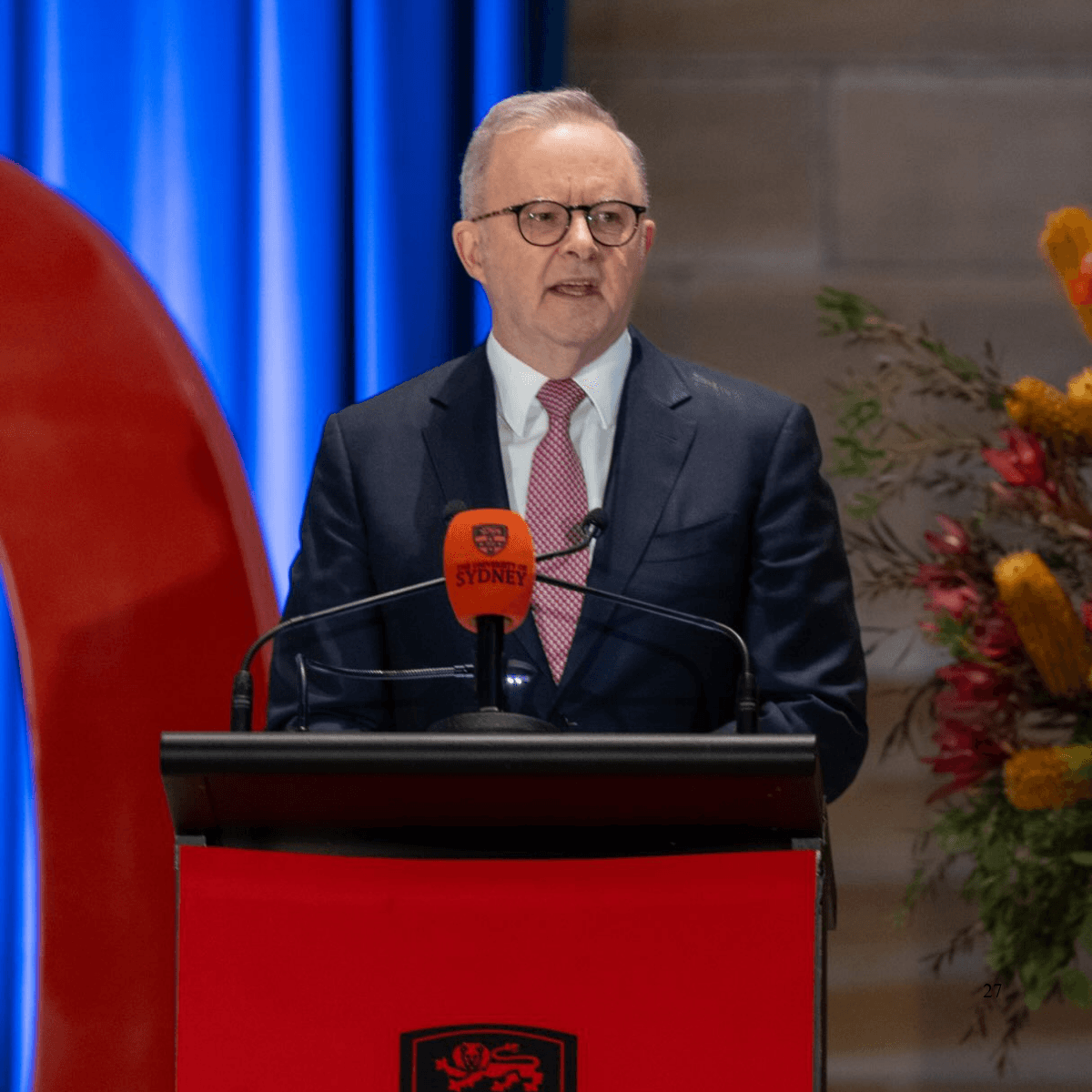
The voluntary era of Australian AI policy ended at a lectern at the University of Sydney on a Wednesday in July, and hardly anyone noticed it go. The Prime Minister's speech was billed as a vision statement, jobs and sovereignty and the future. But sitting in the middle of it was a sentence with a date in it, and dates are what separate policy from intention. Australia will legislate Australian Standards for AI, with a bill before Parliament in early 2027.
I have now read the speech three times. Once as a founder who runs a certification scheme for responsible AI. Once as a trade marks attorney trained to notice when language becomes binding. And once as someone who wrote, only last month, that Australia had chosen government guidance without government enforcement. That third reading is the one that matters, because this speech quietly unwrites the choice.
Four commitments, counted honestly
Strip away the rhetoric and the speech makes four commitments you can hold it to. A set of Australian Standards for AI, put to the states at National Cabinet in August and legislated in early 2027. An Office of AI inside the Department of the Prime Minister and Cabinet, operating from the day of the speech, which tells you AI is now first-order economic policy rather than a portfolio curiosity. Hard rules for large data centres, which must underwrite their own new power supply, pay their full share of grid connection costs so household bills are untouched, ease off the grid when it strains, and treat water like what it is on the driest inhabited continent on earth.
And copyright, delivered with the most feeling in the room. The government has ruled out a text and data mining exception, which means AI companies get no free pass to train on Australian creative work. The Prime Minister's words, not mine. “An artist's creative endeavour is their work and their property. No company should use Australian books, music, art or news to build or train AI without the artist's control.” Australia just planted its flag on the opposite side of this question from most of the world.
The reversal is the story
Seven months ago, this government looked at mandatory AI rules and put the pen down. The National AI Plan of December 2025 set aside the proposed mandatory guardrails for high risk AI and chose existing laws and voluntary guidance instead. It was a deliberate, defensible bet on innovation, and it left a gap I wrote about last month. Government guidance without government enforcement. Principles without proof.
Seven months is a short life for a policy settlement. What changed was not the technology, which was always going to keep compounding. What changed is that waiting became politically untenable. And here is the reading I would offer any business owner. The first legislated standards target data centres and creators, not your chatbot or your rostering system. But governments do not build machinery for one job. Once standards exist in legislation, with an office in the Prime Minister's own department to coordinate them, extending them is an amendment, not a revolution. The direction of travel stopped being tea-leaf reading the moment it acquired a parliamentary date.
Guidance asks nicely. Legislation arrives with a date.
What nobody can tell you yet
The expert reaction converged on one phrase, light on detail, and it is fair. What will the standards say about the ordinary business use of AI, the chatbots and scribes and scoring systems Australians deal with every week? Which uses will be deemed high risk? Who assesses compliance, and against what? None of it is written. If your business is like most in Australia, using AI rather than building it, the honest summary is that standards are coming and nobody has told you what they will require.
Here is what saves that from being useless information. The content of the standards is unwritten. The shape of them is not. Every serious framework on earth, from Australia's own AI Ethics Principles and Voluntary AI Safety Standard to ISO 42001, converges on the same spine. Accountability, transparency, risk management, human oversight, incident handling. Whatever the Australian Standards for AI end up saying, that spine will be in them, because it is in everything. Waiting for the fine print before you build the spine is like waiting for the speed limit to be posted before you learn to drive.
Eighteen months of daylight
Between now and early 2027 sits a window, and what you do in it decides whether the legislation lands on your business as a checklist or as a crisis. Because your customers are not waiting for the bill. They are already asking who reviews your AI, what happens when it gets something wrong, and whether anyone independent can vouch for you. Enterprise procurement teams are asking in writing. And increasingly the buyer is not a person at all but an AI agent, which checks machine readable records and cannot be charmed by a marketing page.
I should be precise here about what certification can and cannot do, because I run a certification scheme and you should discount my enthusiasm accordingly. Our scheme is voluntary and independent. It is not a government program, and no private mark can promise compliance with a law that has not been written. What certification does is put the spine in place now, with independent assessment against the Australian AI Ethics Principles, a public register anyone can check, and annual reassessment. Businesses that do the work this year will read the 2027 bill as a list of things they already do. Businesses that wait will read it as a renovation quote.
The homework worth doing before August
National Cabinet meets in August, and the noise will start then. You want your answers ready before it does. Map your AI use honestly, including the tools your teams adopted without asking anyone. Put a written policy behind it that your staff actually follow. Give AI oversight a named owner, because accountability that belongs to everyone belongs to no one. Check your privacy policy against the automated decision-making disclosures the Privacy Act requires from December. Then take the step that turns all of it from a claim into a credential and have someone independent verify it.
The federal government has just told the country that AI standards are worth legislating. When that message sinks in, every business that uses AI will be asked, by a customer, a procurement team or a regulator, what standard it meets. The ones who benefit from this week are the ones who already have an answer signed by someone other than themselves.
The pen is moving in Canberra. The question is what your business can show before the ink dries.
Syed Mosawi
Syed Mosawi is the founder of Responsible AI Australia and a registered trade marks attorney. He built Australia's certification trade mark scheme for responsible AI, assessing businesses against the Australian AI Ethics Principles across three tiers. Commit, Embed and Govern.
Written by a human.