Will an Australian Child Born Today Ever Be Smarter Than AI? Sam Altman Thinks Not. Here's What Parents and Teachers Should Actually Do About It.
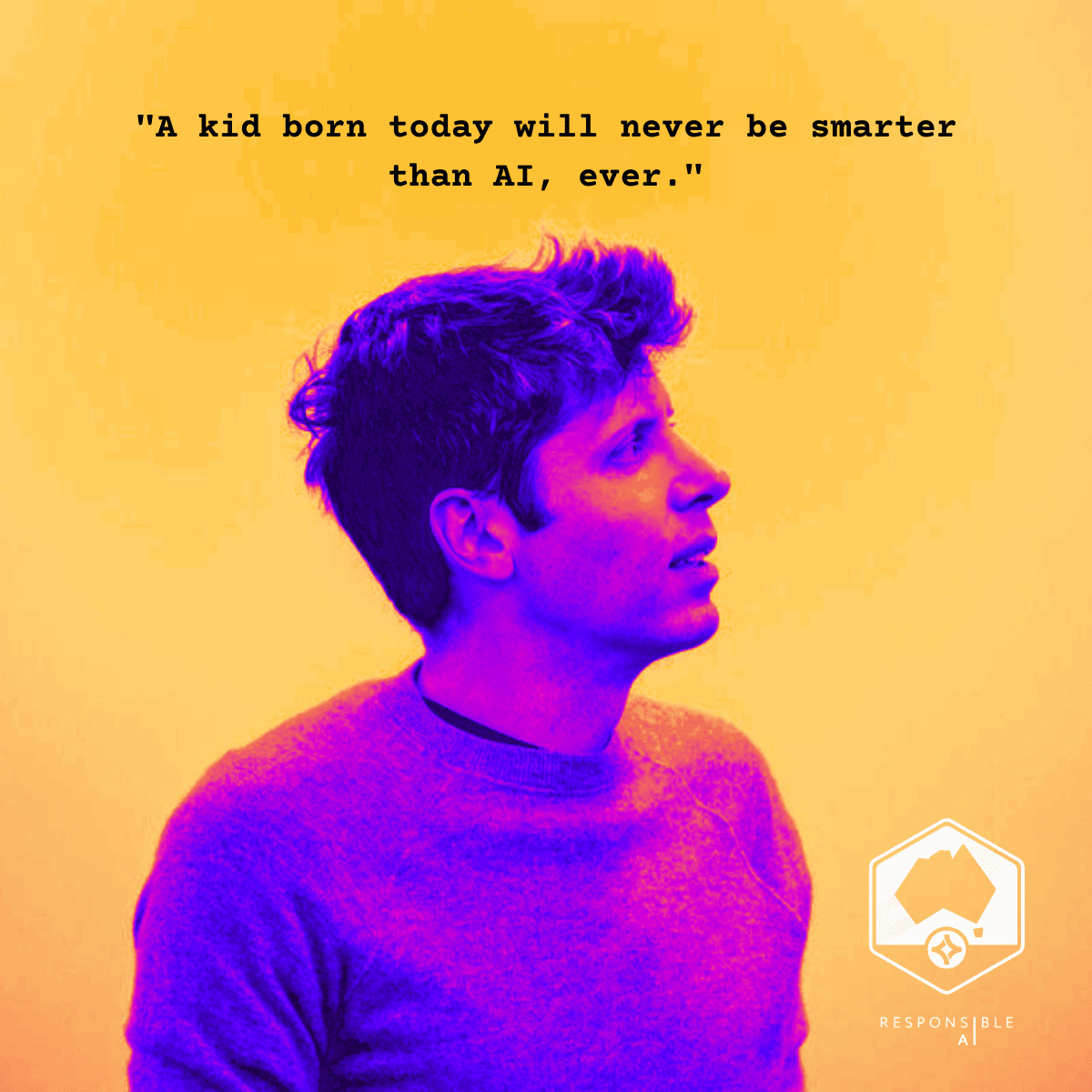
“A kid born today will never be smarter than AI, ever.”
The line is from Sam Altman, OpenAI's chief executive, speaking to journalist Cleo Abram around the launch of GPT-5 in August 2025. It has surfaced again and again since, usually clipped down to its most provocative form, often paired with his follow-up that we will look back and “think how bad those people of the 2020s had it.”
For Australian parents standing in maternity wards, for primary school teachers planning next term, for principals trying to write an AI policy that will still be relevant in eighteen months, this is a strange and unsettling moment. The man building the most consequential technology of our lifetime is making confident pronouncements about what childhood, education, and human intelligence will mean for the next eighty years.
He is also, by his own admission, unreliable about what AI will do in the next eighteen months.
That tension is where this essay starts.
What Altman actually said
It is worth quoting Altman accurately, because the viral clips have done him a disservice in both directions. Here is the fuller passage from the interview with Cleo Abram:
“A kid born today will never be smarter than AI, ever. And a kid born today, by the time that kid kind of understands the way the world works, will just always be used to an incredibly fast rate of things improving and discovering new science. They will just never know any other world. It will seem totally natural, will seem unthinkable and stone age that we used to use computers or phones or any kind of technology that was not way smarter than we were.”
He elaborated on the parenting question in the same interview. When asked what advice he had for raising children in an AI-saturated future, his response was strikingly traditional:
“Probably nothing different than the way you've been parenting kids for tens of thousands of years. Love your kids, show them the world, support them in whatever they want to do and teach them how to be a good person. And that probably is what's going to matter.”
On the OpenAI podcast in June 2025, just months after his son was born, he made the same point in more personal language. “My kids will never be smarter than AI. They will grow up vastly more capable than we grew up, and able to do things that we cannot imagine, and they'll be really good at using AI.” He added, almost as an aside, that he didn't think his kids would “ever be bothered by the fact that they're not smarter than AI.”
Three things are happening in these quotes at once. A confident long-range prediction. A reassuring case that the prediction is fine, actually. And, tucked into the same conversations, a quiet acknowledgement that AI will cause “problematic parasocial relationships” and that “society will have to figure out new guardrails.”
The kids will be fine. The kids might not be fine. He is saying both.
The evidence we actually have
Here is the awkward part. There is no body of long-term research on what happens to a human being who grows up using AI as a permanent intellectual companion. There cannot be. The children Altman is describing are between zero and three years old. We will not have meaningful longitudinal data until they are in their twenties.
What we do have is the early evidence on what AI is already doing to the cognition of older students and adults. The picture is mixed, and the nuances matter.
A 2025 MIT Media Lab study, Your Brain on ChatGPT, used EEG scans to compare people writing essays with ChatGPT, with Google Search, and with no tools at all. The ChatGPT users showed reduced neural connectivity in networks associated with memory and creativity, and struggled to recall what they had written moments earlier. A separate Wharton study with 1,000 high school maths students found those given ChatGPT outperformed peers by 48 per cent on a practice test, then scored 17 per cent worse than the no-AI group on a follow-up exam where the tool was taken away. The crutch came off, and the muscle had atrophied.
A more hopeful finding sits inside the same Wharton work. Students given a carefully designed “AI tutor”, rather than raw ChatGPT, kept their gains in the follow-up exam. The difference was in the scaffolding. The tool that taught them how to think performed differently from the tool that just gave them the answer.
A 2026 systematic review in Computers and Education: Artificial Intelligence synthesised 67 studies on ChatGPT and student cognition. Its conclusion was careful but clear. AI supports thinking when “embedded within inquiry-oriented and scaffolded instructional designs”. In unstructured contexts, it produces “cognitive offloading”, the technical term for outsourcing your thinking to a machine and slowly losing the capacity to think for yourself.
So is Altman right that today's children will grow up “vastly more capable”? Possibly. The evidence suggests they could, provided the adults around them design the experience carefully. Without that design, the same tools that could expand a child's capability will instead quietly contract it.
Where Australia actually sits
Australia has moved faster than most countries on the school policy question. The Australian Framework for Generative AI in Schools was approved by education ministers in October 2023 and is now the national reference document. South Australia trialled EdChat, a purpose-built generative AI chatbot for schools, before most jurisdictions had even lifted their bans. Victoria has released a state policy covering consent rules, privacy safeguards, and curriculum-aligned deployment. The federal National AI Plan, released in late 2025, explicitly names education as a priority area.
The framework is good. The execution, less consistent. Teachers across Australia have been left to interpret broad ethical principles into classroom practice, often without dedicated professional development time and frequently without clarity on what they are allowed to do when a student submits work that looks suspiciously polished.
Day of AI Australia, an annual initiative that ran across hundreds of schools in 2025, has been a bright spot. So has the work of Australian AI literacy researchers like Leon Furze, who has argued consistently that the question is not whether to use AI in schools but how to design assessment and pedagogy around its presence.
What is largely missing from the Australian conversation is the parenting side. School policy can shape what happens between 9am and 3pm. It cannot shape what happens at the kitchen table at 8pm when a ten-year-old uses ChatGPT to do their reading comprehension. That is a household decision, and most Australian households are making it without any framework at all.
What parents can actually do
There is no clean playbook for this. Anyone selling you one is overstating the evidence. But the research, taken together with what experienced educators are saying, points to a handful of practical instincts that travel well.
- Treat AI literacy as two skills, not one. A child should learn to use AI fluently, because they will live in a world where it is everywhere. A child should also learn to think without AI fluently, because the alternative is a person who cannot function the moment the tool is unavailable. These are not competing skills. They are two halves of the same education.
- Protect the struggle. The MIT and Wharton findings both point in the same direction. Cognitive growth comes from the difficulty of doing something hard, not from the elegance of the final answer. A child who uses AI to skip the struggle gets the answer and loses the growth. The instinct to step in and let the tool handle it, particularly when your child is frustrated, is exactly the instinct worth resisting.
- Talk about AI honestly, including the parts that are uncertain. Altman himself does not know whether his predictions will hold. Telling your child that the most powerful people in technology are openly guessing about the future is more useful, and more accurate, than pretending the trajectory is settled.
- Model your own behaviour. If a child watches their parent reach for ChatGPT for every email, every recipe, every difficult conversation, they will learn that the human mind is something to be outsourced. If they watch their parent use AI selectively, deliberately, and with visible thought about when to and when not to, they will learn that the tool is a tool.
What teachers can do this term
For Australian teachers, the practical questions are sharper because they recur every day. A few patterns are emerging from schools that are doing this well.
Assessment design is doing more of the work than AI detection software. Process-focused tasks (asking students to document drafts, decisions and revisions), oral defences of written work, and in-class assessments where AI is not available, are all proving more effective than trying to catch AI use after the fact.
Explicit AI literacy is moving from optional to essential. Students need to be taught what generative AI is, how it works, where it makes mistakes, and crucially, what it cannot do. A child who understands that an LLM is a statistical pattern-matcher trained on the internet is much harder to manipulate, by the tool itself or by anyone using it on them.
The teachers who seem most settled are the ones who have stopped asking whether AI is good or bad and started asking when its use is developmentally appropriate. Year 10 students using AI to refine an argument is different from Year 4 students using AI to write the argument in the first place. Both can be defended. Both require thought.
The uncertainty at the heart of it
Return to where this essay started. Altman is making a confident eighty-year prediction about your child while openly admitting he was wrong about the past eighteen months. Just last week in Sydney, speaking virtually to a Commonwealth Bank conference, he conceded he had been “pretty wrong” about how quickly AI would eliminate entry-level white-collar jobs. The man building the future is openly uncertain about what the future actually looks like.
“Altman is making a confident eighty-year prediction about your child while openly admitting he was wrong about the past eighteen months.”
That uncertainty is not a reason for panic. It is a reason for humility.
What we can say with confidence is that the children currently in Australian classrooms will live their adult lives alongside a kind of intelligence that did not exist when their parents were their age. What we cannot say is whether that will make them less capable, more capable, or capable in ways we cannot yet imagine.
What we can choose, today, is how we prepare them. Not by deciding whether AI is good or bad, but by deciding what we want them to be able to do without it. The capacity to sit with a difficult problem. The patience to write a first draft that is genuinely their own. The intellectual stamina to read something long and complicated. The social courage to disagree with a confident answer. The self-respect to know when their own thinking is worth more than the machine's.
These are not skills AI can give a child. They are skills only adults can.
Altman is probably right that today's Australian children will grow up in a world transformed by AI. He may be right that they will be more capable for it. But the version of them that emerges in twenty years will not be shaped by what OpenAI builds in San Francisco. It will be shaped by what their parents and their teachers chose to protect, in their actual lives, today.
That choice has not been outsourced. Not yet.
Responsible AI Australia works with Australian organisations to navigate the responsible adoption of artificial intelligence. If you'd like to discuss AI policy for your school, workplace or family, get in touch.
Syed Mosawi
Founder at Responsible AI Australia. Building certification frameworks to help organisations operationalise their AI governance and compliance.